Mixing & Mastering Tip #247 ·
How to get solid, consistent background vocals

Ruslan Slatin
Mastering engineer at SLATIN, Madrid
Professional background vocals are not about fancy plugins. They’re about consistency.
The goal is simple: every single backing vocal should feel glued together into one solid wall of sound.
If your background vocals feel messy, jump in volume, or suddenly get harsh, chances are you’re skipping one of these steps. Let’s fix that.
Don’t skip automation
This is the foundation.
It’s not only about “helping the compressor”. The expressiveness and intention of the vocal delivery are shaped at this stage as well.
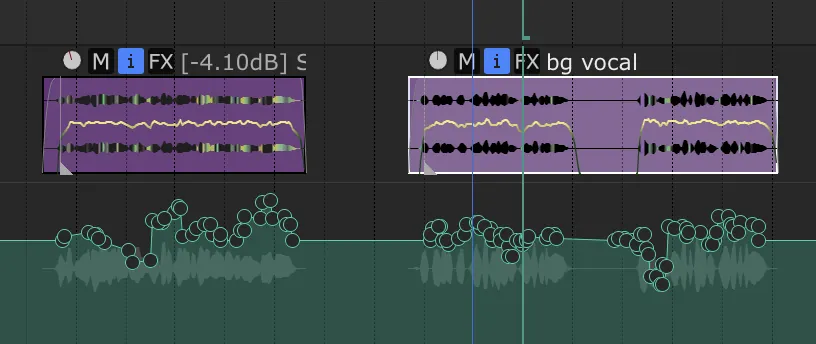
If you want this to be easy, first set up your main compressor, then automate the volume of the takes pre-FX.
Grab the pencil tool and automate the volume by hand. Yes, manually. I know it takes time.
Good automation = easy compression. No automation = fighting your compressor for no reason.
Trust me, this single step makes a big difference.
Compression: lock everything together

Now it’s time to compress. These are the compressors I usually reach for:
- CLA-76, UAD 1176 or Balcony Left
- Distressor, CLA-2A
- R-Vox (also a great option)
Since background vocals usually involve many tracks and adlibs, I wouldn’t recommend super CPU-heavy compressors. You’ll probably end up running dozens of instances, so keeping things efficient matters.
After that first tone/color compressor, I like adding Pro-C 3 with a fast attack. Not to squash everything, but to give the vocals a final layer of control.
Think of it as the finishing touch. It slightly flattens the remaining peaks and helps the entire stack feel tight, solid and stable.
De-essing, or the “S” takes over
This step is essential. Every backing vocal adds more “S” energy.
One vocal isn’t a problem. Ten vocals absolutely are.

They stack together, and suddenly your chorus becomes harsh, sharp and annoying to listen to.
Luckily, you don’t need anything fancy. Any de-esser will do the job. I personally use Waves DeEsser.
One tip though: be a little more aggressive than you normally would. It’s perfectly fine if each individual backing vocal sounds slightly darker on the “S” sounds.
Last tip: don’t process on the bus
Don’t put your entire processing chain on the background vocal bus. Instead, every backing vocal should have its own independent chain.
Compressors react to input level. If multiple vocals hit the bus at the same time, the compressor suddenly works harder. Then, when fewer vocals are playing, it compresses less.
That means your backing vocals will constantly change in volume depending on how many tracks are singing at that moment. And that destroys consistency.
Ideally, give every track its own chain.
Want this on your own track?
I master more than 1,000 songs a year for artists and labels, from stems or a stereo mix. Send me your track and I'll tell you what it needs.
A new tip like this every week, free: join the newsletter.
Work with me
Whenever you're ready, here's how I can help.
 MentoringMix & Master AcceleratorWeekly video reviews of your tracks, live group calls, and the business side of a studio career.By applicationApply now
 Preset packFUSION150 hand-crafted Valhalla VintageVerb presets. Three clicks to the sound you already hear in your head.20€Get the pack
 CourseAdvanced MicrodynamicsFour hours on the micro-level movement that makes a mix feel alive. Joined by 220+ students.149€See the course
 CourseLow End MasteryKick and bass chemistry, so your low end lands on club rigs and earbuds alike. Joined by 500+ students.159€See the course
 SoftwareStudiOSThe software I run my own studio on: deliveries, client feedback, versions and invoices in one place.14 days freeTry StudiOS