Mixing & Mastering Tip #210 ·
Vari-mu for mastering: why I kept the WES Audio tube compressor

Ruslan Slatin
Mastering engineer at SLATIN, Madrid
I picked up the WES Audio Tube Compressor, and this thing is interesting.
At first, I wasn’t sure I’d keep it. Actually, I was tempted to return it.
Why? Because for mastering loud music, I could barely push it past a dB of compression before it started feeling too “laggy”. Even with the slowest attack and fastest release, it just didn’t grab the way I like for high-energy genres.
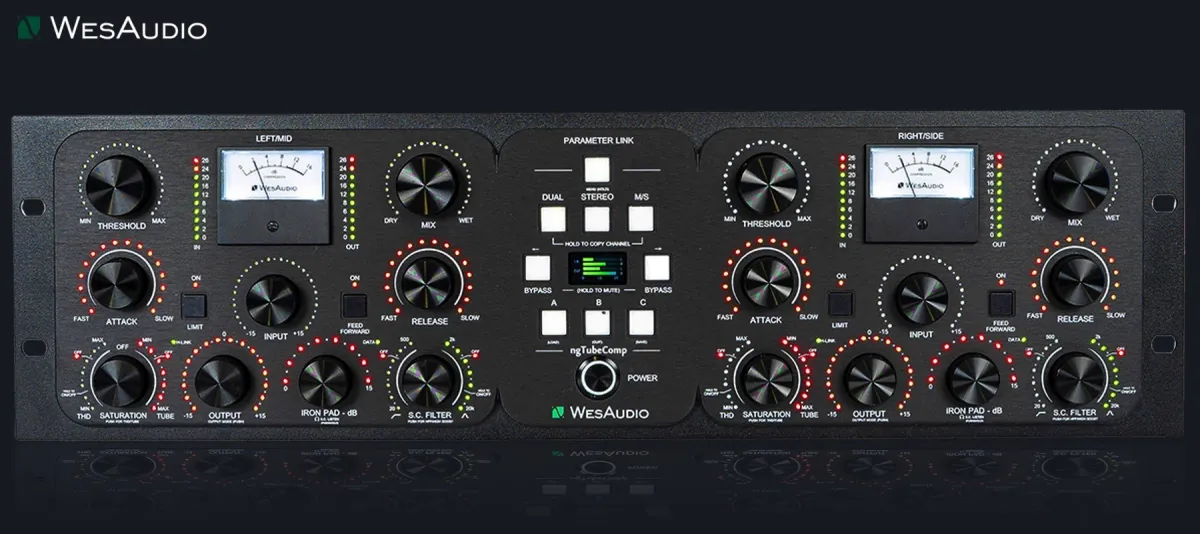
But then I used it more and more, and I decided to keep it.
I kept it for the sound, not the compression
After two weeks of living with it, I realized I wasn’t keeping it for the compression at all. I was keeping it for the sound. The magic inside.
Even just passing audio through it, maybe with a tiny kiss of tube saturation, made the mix come alive.
It added this 3D depth and separation, but still felt natural and glued together. Unreal.
And that’s the funny part: many engineers love vari-mu compressors for exactly that reason. Not because they compress beautifully, but because they add life.
Think of the Manley Vari-Mu. People often barely touch the gain reduction, yet it gives the track that warm, breathing character.
Can’t you get the same thing with plugins?
You can get close, but it is not the same.
In the analog world
- Voltage and current are constantly moving through components that behave in complex, time-varying ways.
- Tubes, transformers, capacitors and resistors all interact dynamically. Their response shifts with temperature, signal level and time.
- Even when “idle”, tubes create a bit of self-noise and micro-modulation, adding subtle randomness that your ears read as air and motion.
- Tubes don’t react instantly. They have memory. That slow charge-and-release (called hysteresis) makes the sound breathe.
In the digital world
- A plugin works in discrete steps, like one tiny snapshot every 1/48,000 of a second.
- Nonlinearity has to be mathematically recreated, using things like waveshapers, convolution or neural nets.
- Most plugins assume static, memoryless behavior, meaning they model a single moment, not the evolving nature of the circuit.
- And to keep CPU use low, they often skip feedback loops and inter-component interactions, which are exactly what make analog feel “alive”.
So when you hear people talk about “analog magic” or “depth”, this is what they’re referring to. It’s not snake oil. It’s the physics of moving electrons, heat and time.
Want this on your own track?
I master more than 1,000 songs a year for artists and labels, from stems or a stereo mix. Send me your track and I'll tell you what it needs.
A new tip like this every week, free: join the newsletter.
Work with me
Whenever you're ready, here's how I can help.
 MentoringMix & Master AcceleratorWeekly video reviews of your tracks, live group calls, and the business side of a studio career.By applicationApply now
 Preset packFUSION150 hand-crafted Valhalla VintageVerb presets. Three clicks to the sound you already hear in your head.20€Get the pack
 CourseAdvanced MicrodynamicsFour hours on the micro-level movement that makes a mix feel alive. Joined by 220+ students.149€See the course
 CourseLow End MasteryKick and bass chemistry, so your low end lands on club rigs and earbuds alike. Joined by 500+ students.159€See the course
 SoftwareStudiOSThe software I run my own studio on: deliveries, client feedback, versions and invoices in one place.14 days freeTry StudiOS